Showing posts with label High Stakes. Show all posts

Monday, May 4, 2015

John Oliver's Illustrative Investigation of the Standardized Testing Plague in the U.S...


Instructions for teachers: "…If a student vomits on his or her test booklet…" and more...

John Oliver does a thorough investigation on the testing plague in the U.S.   A home run of an analysis as he describes who is paying the price, and who is making millions from this travesty.


https://www.youtube.com/watch?v=J6lyURyVz7k

American students face a ridiculous amount of testing. John Oliver explains how standardized tests impact school funding, the achievement gap, how often kids...
youtube.com


Wednesday, December 10, 2014

Standardized Tests are the Failures - Not Our Children

How Standardized Tests Do Not Assess Common Core Standards (Part 1 of 2 Parts)

Packaging "Wonder"
The PARCC (Partnership for Assessment of Readiness for College and Careers) drives the current trend - the Common Core and its Standardized Tests, which bombard American public school children all through the school year.  The College Board's David Coleman and a team of non- educators chiseled out these standards (as in chisel and stone). Coleman claims that this will be instrumental in"cultivating wonder" in every classroom across the country.

The idea of cultivating wonder is a lofty notion. But "wonder" can't be mandated. In the Socratic Tradition, cultivating wonder requires thinking and discourse and investigation - none of which can be measured through standardized testing.

So good luck to any teacher, student, administrator, or parent who tries to find the ways that these assessments actually connect to the standards themselves. Because there is none.

Let's look at the description for the Close Reading standard:

College and Career readiness anchor Standard for reading

Key Ideas and details:

1. Read closely to determine what the text says explicitly and to make logical inferences from it; cite specific textual evidence when writing or speaking to support conclusions drawn from the text. (www. corestandards.org)

Despite the fact that this approach to reading feels like a joyless procedure, I tried to keep an open mind when working with my seventh graders. I have an arts background and would need to lean on imagination and problem solving to work to engage my students and to get them excited about looking at written language.

Our English language is robust and evolved, often strangely, from other languages. New words find their place in our dialogues as they're appointed to everyday use.  Our language is as organic as a rain forest; fluid and changing.  I was eager to work with my students who are also fluid and changing: Seventh graders mostly love to talk and to challenge: We could have fun with this.

This standard includes the study of connotation and detonation.  Different words mean different things to a student - depending on gender, socioeconomic background, nationality, personality, cognitive development, and life's experience.  Depending on who you are, the word HIT - might apply to baseball, a popular song, viewings on a viral You Tube item, or, a slap.

But, there was no curriculum provided. So, burdened by no curriculum, or, re-frame this as unburdened by untried pre-processsed rigid bulleted CC lesson plans, I had a certain amount of freedom to seek out my own resources as I set about to "cultivate wonder" among my students.

No curriculum? Consult with a scholar.

Before outlining lessons, I re-visited Francine Prose' Reading Like a Writer. I had read this book in grad school.  A prolific writer of fiction and non-fiction, Prose is a university professor and a scholar of reading and language.  I love this book - she discusses the explicit and the subtle, and relates how as a student, her English teacher guided her class through King Lear and Oedipus Rex to circle every reference to eyes, light, darkness and vision.  Prose observes: "And searching for every relevant word turned out to have an enjoyable treasure-hunt aspect, a 'Where's Waldo' detective thrill...(p. 4, Reading Like a Writer).

Her book is organized sequentially in the way we approach reading: The chapters are as such: Close Reading, Words, Sentences, Paragraphs, Narration, Dialogue, Details, and the nuanced Gesture. She examines the literal, and how that may be interpreted. There is something for every reader of any age;
plenty for a child who is a concrete thinker to grab onto - and plenty for a child who is moving into higher level thinking to ponder.

Through the rest of her book, which I enthusiastically recommend for anybody who reads/writes and/or teaches any subject she encourages us to roll up our sleeves and immerse ourselves in language.  I wanted to use Prose' book to light the way through this new reading unit, kind of like a powerful utility flashlight - so we could focus on words and phrases through her high beam.

For starters, I brought a few words to the table: Dove, Blood, Hit, and Fire.  Students wrote down their gut response. No correct or incorrect - purely subjective. (that is connotation)

Then we discussed the literal meanings and created a mnemonic for Denotation = Dictionary Definition.

Students' connotations of the words were quite varied:  Another mnemonic: Connotation - Connection: Emotional, Experience.  For the word Dove:  Dove=soap, Dove=bird, Dove=peace (symbolic, higher level thinking here), Dove-venturing bird from Noah's arc, Dove=shy and gentle.
The responses were so individual, which what makes language study fascinating.

Okay, so how does all this kind of reflection and discourse measure up on a standardized test? Before going there, there's another example of student responses to the word Blood.

Blood=hospital, Blood-=relative, Blood=gory, Blood=loyalty, Blood=war

There is no "right" answer for connotation if we have no context around it.  But depending on the context, blood takes on a different shading.  This is a skill to cultivate; it's higher level reflexive thinking -- a good reach for seventh graders.

Later we examined the connotation of the word rain in the Longfellow poem The Rainy Day. In this poem, rain signifies sadness and loss. How different from the joyful rain Langston Hughes celebrates in his April Rain Song.  We spent the rest of the year, until the tests, looking closely at the denotation and connotation of language in all that we read together.

What I had learned to share with my students: Attached to every word we know and use is our whole life's experience, and it's all rich.  I wanted them to keep experimenting with reading and writing and speaking.  They wrote daily reflections, poems, short paragraphs and essays - these were how I checked in on where they were in their understanding.

Fast forward: Test time:

Based on all the sound and fury around the goals of Coleman's Common Core, for some reason, I had
anticipated that a whole new kind of test had been created - one that would suitably measure cultivated wonder.  But on the first morning of the test week, as I flipped through the booklet, my heart sank.  These tests resembled the earlier ones from Bush's failed No Child Left Behind mandate.
These were zombie tests, rolled out from the closet of the undead.

The reading was so voluminous, that many students were unable to complete it. There was no time to highlight or jot notes, as we had slavishly practiced in class.  The writing section asked students to spit out answers - not to craft their writing.  When time was up, my students were frustrated and some were tearful as they threw down their pencils.  All the liveliness of our collective learning was yammered down flat - in a boring and insulting drill.

It was as if I'd coached them to overdress for an upcoming event, when actually all this occasion called for was to dress in a standard uniform that didn't actually fit anyone.

Problem #1: And Now for Something Completely Different.

If you've never perused a standardized ELA test, what you'll notice straight off is that the four or five reading passages have nothing to do wit;h each other.  They are decontextualized. Students read first about the Klondike Gold Rush (content not covered in class - no curriculum provided for this test), answer the questions, then skip on to ingest an unrelated passage about Diamond Veins in Africa, then leap into a disembodied passage from Louisa May Alcott's Jo's Boys (an author and book not familiar to most seventh graders, and developmentally inappropriate for many).

Because of the random quality of passages, students have just enough time to maybe develop a mild interest in the information, but then it's over, and they have to promptly move to the questions without time to process what they've just read.  It's reminiscent of the old Monty Python sketches: And Now For Something Completely Different that roll along with clattering speed.  Students have to constantly switch gears.  It's impossible to pick up on the rhythms and choices the author has made, which are
key points to reading closely, as Prose suggests.

Students have no prior knowledge of the content, so they're immediately placed at a disadvantage. Ramp up the time pressure, and I can't think of a better way to teach students how to dread reading and writing.

Important to note: The reading content (we're not asking for the questions)  of these tests are kept secret and unattainable, kind of like the Holy Grail. (Monty Python context).  That's how the test pushers keep a "leg up" on our kids, as they "race to the top."

Problem #2:  But all the work we've done doesn't show here.

As she guides us through careful word study, Prose provides us with 1 - 3 paragraphs minimally or
even a full page from an author's story so that we are provided with abundant clues as we infer what the author wants us to pay attention to. It's similar to looking at an Impressionist painting: We need as much of the painting as possible to stand back and better understand how each brush stroke is part of a larger image.

But the reading clues in standardized tests are stingy.  There's no room for full-bodied interpretation of a passage.  It's like giving the test taker a portion of a brush stroke and expecting him to "get" the full picture.

Let's have a look at this excerpt from a standardized test passage (2013 - Engage NY - 7th grade ELA exam):

Passage excerpt from Earth and Water and Sky by Brian Bushemi
(note: Brian Bushemi's novels are not on the touted CC Lexile that supposedly matches readers with books.  Students are not familiar with him. He's not Walter Dean Myers or Jaqueline Woodson or Suzanne Collins -   It is likely that Bushemi is a writer employee of Pearson, the British test materials company that has an enormous contract with PARCC. )

My point: Kids are not being tested on authors that they actually read. So why are teachers required  to choose books from the lexile?

(lines 25 - 31)

        "David stood up and continued toward the Thinking Pond. Suddenly, he heard a sharp, whining sound like the engine of a high-flying jet airplane.  It was followed by a crack! like a whip being snapped, only a thousand times louder.  Then a ball of fire roared overhead, followed by a searing gust of wind.
          The shock wave knocked David to the ground, his ears ringing. A second later, he heard an explosive, hissing crash up ahead.  A rush of air and hot steam billowed through the trees, and he covered his head as it washed over him."

And the "close reading" questions:

Which sentence from the passage best shows how powerful the meteorite was?

A "Suddenly, he heard a sharp, whining sound like the engine of a high-flying jet airplane."
      (lines 25 and 26)

B  "Then a ball of fire roared overhead, followed by a searing gust of wind." (lines 27 and 28)

C  "The shock wave knocked David to the ground, his ears ringing." (line 29)

D  "A second later, he heard an explosive, hissing crash up ahead." (lines 29 and 30)

Using Prose' flashlight beam, it's evident that Bushemi spends many sentences describing the power of the meteorite. The test assumes that students know what a meteorite is; earlier in the passage the boy muses on what it might be. A student who has no prior knowledge (we did not study meteorites in class), and thinks differently, might rightfully infer that it is an imaginary object, similar to A Thinking Pond as a magical notion.

Letter C shows that David is knocked to the ground (an idiom phrase - a challenge for an English Language Learner), but what exactly is a shock wave? Do meteorites emit shock waves that can knock people down?

A, B and D are good answer candidates for showing the power of the object, if one closely reads the words sharp, ball of fire, searing, explosive, hissing crash.  The connotation of all of those words is disturbance.  But the students aren't really being asked to work with connotation here, nor denotation, even though the standards cite those as launches to wonder.

Keeping in mind that many seventh graders are literal thinkers, it's easy to get this one wrong. There aren't enough clues. The offerings here are stingy. Thinking needs to be tamped down to it right. It's about navigating tricks, test maker's bias, and splitting hairs.  It not a scholarly exercise.  Alas, the joke was on us because the game was rigged. (casino context)

      
Neither does the reading of the other passages or questions bear any resemblance to reading with care. Many teachers like myself spent so much time "cultivating wonder" in the months before only to be astonished that none of that work can be measured by this test.

What happened?

My students' test scores tanked.

In Coleman and company's zeal to reform public school, they created a slipshod and hackneyed way to measure learning.  Paradoxically, these high stakes tests are insulting in design because the bar is so low.  They don't in any way deliver on the high falutin' dreams of Coleman's Common Core, and
their relationship to these standards is dysfunctional.  Yet, they do have the power to predetermine a child's educational future, to determine which schools are "failing", and the power to destroy teachers' careers.

They flatten what is individual in thinking, they degrade true scholarship, and discourage "thinking
differently"; peculiar to a culture that allegedly emulates "thinking outside the box." (corporate context).  Our children deserve better.

It all demonstrates that Coleman, Gates and the rest of the "reformers" have no idea what they're doing. Let's reform this reform, for starters; trash the tests.  They are failing our children, not the other way around.

                                                                ****************

Coming next: Part 2: Why conceptual thinking is the way of today and the future,  and how standardized tests cannot measure this.


Monday, April 7, 2014

Yes, And...Embracing the Awkward: Some thoughts on what rigor in school actually means


Improvisation is an edgy, spontaneous art form – and completely unscripted.  This means that you don’t know what will happen next, or what your co-players will do or come up with.  Unscripted is the key word.  When you engage with this, you’re offering yourself up to be thrown off and disoriented, uncertain, and inescapably awkward.

A while ago, I started an Improv Club with some energetic high school students at their exurban high school. The school was surrounded by what were once cow pastures in the furthest reaches of bucolic Westchester County, where kids have to make their own fun.

The club’s numbers grew as kids found they could let off steam in this after-school venue.  Kids who had sat numbly in class all day got to bring their most daring and “outlier” selves into room L207. But, with the exception of the two self-appointed “presidents”, none of the kids had any experience with improv, and had no clue as to how to play without a script.

I enlisted the help of my son, Zack, who is a professional improviser.  This sounds like an oxymoron, but he does earn a living improvising and making people laugh. He introduced the club to the most important principle:  Yes, and… This is the phrase you keep in your head while your co-players verbally lob something at you. 

The basic Yes, and…game might go like this:  Two students stand up:

Student 1 might say: I just got back from Mars.

And Student 2 says Yes and…is that how come you have green skin? …

Student 1 says Yes and…their spaceship is right over there…

Student 2: Yes, and…Can I go too?

At this point two more students may join in.

Student 3: Yes, and…This is my Mom and I would like to send her to Mars. 

Student 4: Yes, and I’m his Mom. I packed a lunch and weapons in case they’re not friendly…

There’s an emphasis on speed: Too much “think” time, and the game falls flat.  And, the second you think or say “No”, the improv dies on the spot. 

Frequently kids would get tongue-tied and go blank, flail around, and occasionally fall on the floor and groan – When it doesn’t fly, you blow your cover and everybody sees that.  But isn’t that the true nature of learning something new?  It’s messy and unpredictable.  The members soon changed the club's name from “The Waxed Beans” to “Embrace the Awkward.” 

Awkwardness? In our school?

In spite of its omniscience, we don’t like to associate Awkward with School.  We’re surrounded by the shrill rhetoric: Succeed! Achieve! Score High!... Stumbling and falling? Not in Our School. 

In reality, school is infused with awkwardness at every turn. Growing bodies are awkward, teachers are awkward, technology does weird things; the day is packed with socially confusing situations. Everybody did the math wrong today and it’s only first period.

As students reach to learn something new, they hear Wrong. Not it. You didn’t get it. Nope:  The daylong incantations of bad news.  “No” stops the learning in its tracks and shuts the door, like a failed improv.  

Yet, we are improvising as we learn.  Zack describes how an improviser approaches the unknown:  He or she is somebody who is willing to commit to a choice – If, say, I were to go onstage and do something funny with my body. The audience might just stare for a bit. But I make a commitment to keep doing that funny body thing.  They start to get it. They laugh. I then make it even more specific and do it harder.  Then I get past the fear of not knowing what will happen next.

All tangled up essays, sciatica, and finding the snakes 

This changed the way I taught writing because I wanted to help my students get over their fear of writing something wrong, and to open up what had been shut down over the years. But here of course, students aren’t doing something funny with their bodies.  They’re doing something “funny” with their writing.  

Aside from a few exceptions, on the whole, my students’ essays are filled with fragments, strange spelling, inconsistent paragraph spacing, disconnected ideas, missing citations. They get all tangled up in words used incorrectly and in the wrong context: It is a festival of awkward writing.  Yet, the effort that students put into a labored-over essay is evident – and the sheer energy of their effort activates my sciatica and fires up foot cramps.    There is something committed about their awkwardness.  

According to Zack’s earlier description, this kind of commitment is needed in order to push further into the unknown.  I began to see writing in a new light, and realized that my students were actually going way out on a limb to show me the insides of their minds, and their thinking processes.  

What a gift to reframe my role in this way:  It was my job to identify the mistakes, in the same way it’s a herpetologist’s job to go up to the mountain and find snakes.  Couldn’t we play with this?  Instead of no, wrong, you have a run-on sentence here, I learned to work with Yes, and - you have three thoughts going on here.  Yes, and- let’s separate those with commas.  Yes, and- this idea is ready for more development…Yes, and- this essay is ready to be organized now…

This became an energizing way to teach.  Students were writing more.  Teaching and writing became more interactive, and more filled with possibilities – like a game.  The principle of improv had opened up the playing field.  Kids were allowed to commit to the “wrong kind” of writing, yes, and – I could guide them toward more clarity.  It opened up our book discussions too – Beginning with the obvious and uninspired student statement: Jay Gatsby was a rich guy… Yes, and – why was it important to him to be a rich guy?  Odysseus took a long time to get back home. Yes, and – what was Penelope doing that whole while? 

If we’re willing to commit to putting it out there, even if it’s wrong and awkward, we’re in a far better position to learn something new.  The opposite would mean to stay cautious, shut down, and “safe.”  Being willing to commit to the unknown and play it harder is the rigor part.  Rigor can’t be thought of as an outcome.  It is a process. Even though it’s a noun, we should think of it as a highly active verb.  Instead of setting rigid and narrow specific outcomes, a rigorous curriculum should invite audacity, uncertainty and mistake making.  The latter is a far more sustainable kind of learning in terms of student and teacher energy.

Without the awkwardness that accompanies new learning there’s no forward movement.

We’re probably engaged with rigor if part of our brain wishes that we were doing something else that will provide some escape from the present task.

What if teachers applied Yes, and…to solving math equations, the narrative of history, and science labs? In what ways would teaching shift?

To become a better coach, I had to become a more patient teacher, even though patience is not included in the criteria on the evaluation forms that administrators fill out during Formal Observations.  Also, in conferences, I rarely hear parents or teachers say – Yes, and – if we’re more patient, we’re going to see Kevin understand this or that concept…Let’s give him more room and time to play with this. 

“Real life” messing up

Not too long ago, I chatted with a friend who has been an insurance attorney for years, but has decided to broaden her career in learning about courtroom law. Similar to my Embrace the Awkward club students, she is deliberately throwing herself into an unscripted situation – or rather – it has a script, but she doesn’t know what it is yet.  And, similar to the improv students, she has to field verbal lobs from other players, including the Judge, on the courtroom floor.   “I don’t know what I’m doing!” She told me. “I think the concepts are similar to insurance law – but the language and terms are so different!  I’m shadowing another attorney, but he had to leave the courtroom and when I approached the bench, I was scrambling for the right terms.  I’m standing there just sort of stammering… looking for my notes."

I commented that learning new things, no matter how old we are, is so uncomfortable. 

“I so get my fourth grader now –“ She nodded. “I get what my son goes through when he’s struggling in school, trying to get something like the math.  Based on what I went through this week, I understand now how hard school may be for him.”   

If we adults are willing enough to stay in-tune with our own awkward learning, like my attorney friend, we become sensitized to the peak and valley experiences that our kids are having throughout their school day.

Recently, I chatted with my lawyer friend again. "How’s it going?" She broke into a smile. "Much better!  I’m finding my way around…its making sense now."

When we watch toddlers who are powered by the commitment to take those first awkward steps, we cheer the falling down as well.  The falling down is part of the rigor in learning how to walk. We praise, we snap pictures, and instantly zip them off to everybody we know.  We shove the furniture out of the way to give him more room to step forward and to fall down.

Can parents and teachers cheer on, with the same kind of enthusiasm, our older kids as they sweat over essays and wrestle with math equations and science labs? Are we courageous and open minded enough to push aside our own “preferred learning outcomes” and instead, embrace the awkward in learning? 

Let’s clear the space so they can play with whatever is in front of them, and follow Zack’s suggestions-- 

Make the commitment, forget about what scares you and throw yourself into it.
                   
                                                                     ***************

Monday, March 31, 2014

Standardized Tests: The recipe for creating passive and shut down students


In teaching writing to Middle and High School students,  I've found that with growing frequency, students sitting with pencils or pens over sheets of paper will jot down a sentence, maybe two, then look up and ask "Am I doing this right?  Did I write the right thing?"  English teachers can't really teach writing, we can only guide kids to get in touch with their thoughts, get them down on paper and take steps to elaborate.

Writing is hard work anyway, but when a student is immediately filled with doubt, and doesn't trust his own ideas or thought process - a teacher's task in helping a student coax those ideas out to deliver them to the page is extra arduous.  The teaching becomes helping kids to first trust themselves to be willing to take a risk with a beginning sentence, before even approaching the craft of writing. I've turned into a writing therapist. "Go ahead and write it, even if you think it's wrong. You've got to start somewhere. You can always edit that out later. Trust yourself."

I find the same disturbing trend when we have Socratic Seminar or fishbowl discussions.  We begin with student composed questions about the novel we are reading - I put the question out there, and the students, sitting in a circle, uncomfortably stare back, many, like deer caught in the headlights. I give appropriate "wait time" - then frequently, say: "Somebody throw the first pitch. Offer up an idea. Don't worry about saying the wrong thing.  Get it started!"  Finally, after a minute or so, a student  steps up (often trepidly) and gets the discussion started.  Clearly, we need to have more of these discussions, so I include them as a regular classroom practice, in spite of time constraints, to give as many students as possible to  hear their own voices and often, once they begin, some of them are able to take the idea baton from another, and run with it.  But, such an effort to get them to speak, and to write!   Maybe an idea is well-grounded, maybe not, but offer it up kids, say it.  Give us something to work with here.

For students to collectively have such self-doubt at ages 12 and 13, an age where verve and an exploratory spirit are natural characteristics and necessary to growth-  is a troubling symptom of something or someone putting that self doubt there.

I sure didn't put the self-doubt there. Nor do most English teachers.

The something that invites a kid's self-doubt is the standardized testing culture that had accelerated with No Child Left Behind and is further amplified now with Race to the Top.  Even teachers and administrators who reject these tests as viable assessment tools find that the encroaching  Culture for Testing is creeping into their schools and classrooms more insistently, like a paralyzing virus in a science fiction movie.   

Tremendous energy and resources are fed to test prep and standardized tests, which are filled with the reading of passages that are in no remote way meaningful to students' experiences or prior knowledge.  The questions invite no conceptual understanding, or even a gutsy try: They are focused on the scavenger hunt of finding micro-facts within the passage.

Any child who happens to think differently, interprets a passage differently, or, has her own connotation of a word or phrase - runs the risk of getting the answer(s) wrong. (But wait a minute, doesn't our real life culture emulate those who "think different"?  What kind of mixed message is being sent?)

As one of the crustier, more voluminous passages in last year's ELA exam was all about striking gold in the Klondike - I watched my students, bent over this passage, puzzling over, I imagined, the word Klondike. To many 7th graders, the connotation of the word Klondike is, well...ice cream wrapped in a thin layer of chocolate.  I got distracted myself, thinking about the package of Klondikes we had in our freezer at home.

I'm going out on a limb here to "play" with this test passage topic:  Hypothetically, if we were having a "regular" discussion about the Klondike gold rush - (a stretch, because it had nothing to do with the novels or contemporary social issues that we discussed and wrote about in my "regular" curriculum) as we were focusing on close reading - we'd approach the word Klondike, as my kids knew it.  Ice cream.  My question: In what ways does the Klondike gold rush connect to Klondike ice cream?  Why do you think the people who created the ice cream bars chose the name Klondike?

The Common Core touts what "it" refers to as "close reading" as a standard, and we had a number of sessions when as a group, we engaged with what that might mean. (I used Francine Prose's excellent book Reading like a Writer as a blueprint for approaching this.)  We worked with denotation and connotation - and how our experience as individuals affects the way we might think of a word like Klondike.   Once my students (by January) had mostly shed their fear of saying the wrong thing, we had great fun with word talks.

But---back to the test: The actual Klondike passage was so long and onerous to read, that nobody had time to read it closely, or thoughtfully, and complete all the micro-fact answers. I'm willing to bet that lots of students had to try to back away from their distractions to be able to finish the test.  Most of my students did not finish it.

In spite of all our attention to close reading, from September to March, under my guidance, my students were not prepared for what awaited them.  As a teacher, I didn't get it "right." For a few moments,  I had a complete flash of identification with my 125 students who had felt the discouragement of not "getting IT right".  Fortunately, I'm an adult with a Masters in Education and Arts (where "the right answer" doesn't exist) background, so that identification quickly passed and I went back to my usual quirky thinking patterns.  I have empathy for new, young teachers who don't have the kind of resources or experience or backgrounds that veteran teachers have.  These teachers are being conditioned to solicit the "right" answer from students. Their careers are at stake.

To sum up this anecdote - there is no opportunity for authentic close reading on these tests. The tests lie, the CC "standards" lie.

You can't get it "right" as a student or a teacher when the test game is rigged this way.  You can never get it right when you have to leave who you are and what you know at the door of the classroom on test day.

When students are conditioned in this way, year after year after year to "get the correct answer" - is it any wonder that they are blocked in their writing, and afraid to throw an idea into the discussion circle?  What are our students being groomed to be?  Compliance is now valued over originality and risk taking.  

Like my students, I felt demoralized after these tests were completed.  Who wants to play this game anymore?  

The day when the last exam had been collected and packaged, one of my most conscientious and curious students approached me and said "Ms. Willis, can we get back to our novel discussions now?"

I said "You bet. It does seem a long time since we looked at the novel together."

"Julie" sighed and said "We're used to these tests. We've been doing the test prep and tests since 3rd grade."

The resignation in her voice was haunting and something I will never forget. The growing sense of alarm I had felt over the passivity and compliance of most of my 125 students- was addressed in her comment. I understood that these kids had been conditioned just to get through the tests, and to put as little of themselves into the whole process as possible.

They have been taught over the years by the test culture that it's easier to be silent and comply than it is to take a risk and put some of your real self out there - in writing - or in discussions.

For some kids, many kids, it's easier now, under this test cloud, to be invisible, or, just let somebody lead you through it.  It's okay to be a sheep.

This is frightening.


Monday, March 24, 2014

Boys with Heroic Names


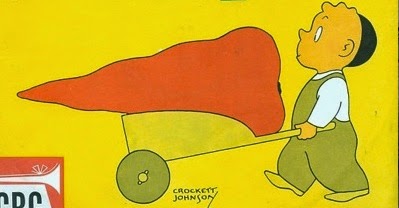
                                           The Carrot Seed by Ruth Krauss, picture by Crockett Johnson. Harper&Row 1945

Deep in the Bronx today
in a school mostly forgotten
except at test time
the third grade exam
was administered
to Tristan, Calvin and Axiom
in the faculty room
with its stained furniture,
odors of discouraging
Tupperware lunches, and
teachers' frustrations over
hazy causes and ancient battles lost-

The whispers 'round school -
High Stakes

Eight year old lives in the balance:
to lose and hang with humiliation?
Or to:
slash the head off this test, only to have
another grow back in its place?

They say a true hero knows he's going down
but goes there anyway -

Legs dangling off the chairs
these three
pencils scratching in circles
yawns - stoical chins
and one runny nose
Eyes on questions
and passages aimed to trick
and crush
like the clashing cliffs
Jason and his Argonauts twisted through -

Then - pencils down -
the tests are ziplocked, sealed.
and carted away in unmarked vans
like so much toxic waste.

Ok now, palms up:
the medals for Valor
are awarded
and they unwrap the foil
from the melting Kisses
that had softened in my pocket
from the heat of the morning.

~ Jane Nixon Willis